Sunday, 15 March 2020

Dove music therapy program brings joy to the dying


I would love to share this as it was very informative, and close to what I do day to day around the hospital wards!


Wayne Miles has not got the energy to open his eyes, but a faint smile flickers across his face as he silently mouths the words to the John Denver song Some Days Are Diamonds.
The 59-year-old Glasshouse Mountains man is dying from cancer, and amid the pain and grief music provides solace.
The former truck driver's love for country music is being nurtured by music therapist Tracie Wicks.
She sits with him at his bedside, strumming a guitar or playing the keyboard, and crooning Slim Dusty and John Denver songs that fill the dedicated music room in the Dove Palliative Care wing of the Caloundra Hospital.
The Dove music therapy program is funded by community donations to Sunshine Coast Hospital Foundation, Wishlist, and has been operating at the hospital since 2016.
Ms Wicks wheels a piano keyboard and guitar bed-to-bed, but a new music room that opened this year she says has added to the patients' experience.
"It's created a beautiful space for families and patients to come," she said.
"Having a space away from the hospital room, which is very clinical and has lots of equipment, to a space that feels homely and comfortable allows people to settle in and enjoy music therapy."
As his cancer progresses, Wayne has participated in music therapy on each admission to Dove over the past year, and Ms Wicks has learned his musical tastes.
"In particular he enjoys John Denver, so I played Some Days Are Diamonds — which is very relatable in this situation," she said.
"The other song I played today was Lights on the Hill [by Slim Dusty] which Wayne relates to through his days as a truck driver."
Ms Wicks will have a go at any genre of music a patient requests — from ABBA's Dancing Queen to a Wiggles tune for a young family member.
She has also been asked to belt out Eminem and AC/DC.
"When I work with a patient it's really important to find out what music is meaningful to them," she said.
"I can't say I was that good at rapping Eminem though," she laughed.

Bringing back memories

While listening to music helps patients on a physiological level — reducing the perception of pain and feelings of anxiety by reducing heart rate and stress levels — its impact on an emotional level is profound in a palliative care scenario, Ms Wicks said.
"We know that music is very strongly linked to our memory centre, bringing back memories from our life, and that is often very important for people facing the end of their life," she said.
"To sit back and review your life and think about your achievements and milestones and talk about the people you love.
"For Wayne, relating to songs is a way of expressing himself, telling his story."
With her help, Wayne wrote the lyrics to a love song for his wife, Cheryl, titled You Were Meant For Me.
"[The song] expressed their love story and in that he also gave thanks to her for caring for him throughout the past few years, particularly after his diagnosis," Ms Wicks said.
"The last verse he wrote was about saying goodbye and his wishes and hopes for her.
"Wayne actually sang the song himself and we recorded it and were able to gift that to Cheryl — something that becomes a legacy that Wayne is very proud of."

'Having some joy'

For the families of patients in the palliative care wing, music therapy is just as meaningful.
"Sometimes it's just about lifting the mood in the room," Ms Wicks said.
"Families want to come together and they don't want to have medical conversations. They actually want to have joy and to celebrate being together.
"Often in a session there may be five or more people and people may request songs that they remember together.
"So you are creating new positive memories, and when they look back to this very difficult time in their life hopefully they can remember some of these moments of actually having joy —of sitting around singing or listening to music together."


Extracted from:
https://www.abc.net.au/news/2020-02-19/music-therapy-program-brings-joy-to-the-dying/11976120

Prayer for a Pandemic (author unknown)

Prayer for a Pandemic (author unknown)
May we who are merely inconvenienced
Remember those whose lives are at stake.
May we who have no risk factors
Remember those most vulnerable.
May we who have the luxury of working from home
Remember those who must choose between preserving their health or making their rent.
May we who have the flexibility to care for our children when their schools close,
Remember those who have no options.
May we who cancel our trips
Remember those who have no safe place to go.
May we who are losing our margin money in the tumult of the economic market
Remember those who have no margin at all.
May we who settle in for a quarantine at home
Remember those who have no home.
As fear grips our country,
Let us choose love.
During this time when we can not physically wrap our arms around one another,
Let us yet find ways to be the loving embrace of God to our neighbors.
Amen.

Happy 79th birthday to my wonderful client

Happy 79th birthday to my wonderful client
You've amazed me in so many ways -
When you're anxious at times, it goes away in a few seconds when you start touching the piano...
You'll never resist music, you always welcome music in any form, instrument, singing or so
You're even learning new songs every time we meet!
You could even hum a tune after a split second of the music playing ....
And your commitment to join every single concert you can ...
Now you've completed a book of all the songs you enjoy singing and playing, what a wonderful achievement!
It's a joy and pleasure to be able to make music with you, keeping music alive!!
Music therapy can assist with memory, relaxation, behavior, anda lot more, see :

Monday, 13 November 2017

喜樂充滿你

Joy Of Happiness

這首歌的誕生,沿由於2015年南區支持小組音樂治療工作坊的舉行。那一連數次的工作坊展現了病人無窮的創作力,及他們對生命的抱負和執著。當天工作坊的情形仍歷歷在目。

我們是次工作坊的主題是"快樂"。我們先聽過與快樂相關的歌曲,也彼此分享。在創作當中- 我們分享到甚麼事情會讓我們覺得"快樂"。討論期間病人分享能享受一息空氣,清晨陽光的美麗已是"快樂",有義工分享和家人相聚的珍貴。。。奇怪的是,許多參與者不約而同的認為最快樂就是透過康恩認識主耶穌,這是好得無比的禮物。其他病人不單未有反感,反而問及主耶穌和信仰的問題。。。他們說道,我們豈不都有從神而來的"喜樂"嗎? 我們擁有的"快樂"已超越快樂,成為永恆的"喜樂"了!

不久之後,一些義工和病人相聚傾談歌詞,認真的作出修訂,過程中也分享到自己對生命和信仰的點滴。他們提到,他們看到彼此支持鼓勵的重要性,更從詩歌創作中對生命有新的感受。

詩歌創作後,病人和義工勇敢地在康恩的晚會裡獻唱,當中有病人已數年來沒有晚上駕車外出活動,亦有病人感動流淚。。。當晚會眾,醫生,義工們都一起唱頌這首歌,場面感動。現在此曲彷彿成為支持小組的主題曲,一再在支持小(組),開放日,各聚會中反覆唱詠。

病人告訴我,他從未想過自己會這麼喜歡音樂,更從未想過能將自己最希望傳遞的訊息以一首歌送給親朋。現在他會更積極面對人生,傳遞福音。

現在從詩歌創作,修訂,錄影,獻唱,直至現在詩歌的錄製,都看到病人對詩歌中訊息的重視。
病人和義工們借此詩歌告(訴)大家他們最珍貴的禮物- 天父主耶穌- 盼望你也能明白他們的心聲。

願喜樂也一樣充滿你!
共勉之

註冊音樂治療師
Hanna Tsoi

Reflections

Reflections 

Its been quite a few years since I've started my work at Oncology and palliative care alongside with other work. I could still remember the calling of working in this field during my masters study, with the voice saying, "be with them, it will be much needed". I simply followed it and never expected it to be such an amazing journey.


It has never been easy. Yes, the work is not just about rainbows and butterflies. Singing and playing music at bedside with the patients and families, or having time together was just an intervention. From seeing patients at home to being at hospital, there were many moments that I recall families with desperate faces, in need of support right in the moment. After work at my volunteer work CanCare, there were many urgent moments of people calling and seeking for help...


Nevertheless, in hopelessness and desperation, it is very rewarding to be a company. To walk together. It is most rewarding seeing families recall the moments- yet still rejoicing in the time of suffering. There were numerous families expressing the need of support with those few lines of music. It is most important seeing families grasping what's important, remembering and believing. I myself have also been moved by music as an expression.

With the circumstances I've been through, It really reminds me how to truly walk in light. How to make your life count. How to truly live a life that He lives. Do things that matters to you. Live every moment well.
Thanks my great friend...it's been a year. It was one of the toughest years I've been through... seeing you go through so many treatments. However, you've taught me so much and I'll continue to remember the way you have walked the tough journey. You were so strong in faith despite of the circumstances. You had such positivity and joy. Most importantly, you consider others' faith and eternity more than anything else. We will continue the way you loved others. Words cannot express more, but I love you so much 
Even though it's a tough journey, it has been a very rewarding life journey. I cannot thank more of my families and friends, as well as the very special someone walking alongside with me.

"I will rejoice. In every season
I have a reason to sing,
I have a reason to worship."
- Desert Song

May music continue to speak the melody of life for many.
Keep rejoicing. 2017 
Many blessings ahead.

Mental Health and Music Therapy

Dear all,

It's been a while! I just want to note the benefits of music therapy and mental health!
Music is essential for mental health , knowing music is accessible anytime, anywhere.
It could connect souls and minds at mind for many times.

- Australian Music Therapy association

Please have a look below for more information: 
https://au.reachout.com/articles/how-to-use-music-for-mental-health

Sunday, 18 December 2016

Rest and Balancing :)


These few months it's been hecticly busy, with new work and new clients! However, I have come to realise the importance of balancing my life with work. Doing something you like as work can be so satisfying and tempting to constantly think about work and make it constantly on my mind. I have set a few things for myself, hope it's helpful for yourself as well!

1. Make time - you can't produce time, but you can make time. Spare time to do certain things
2. Prioritize - First things first, one thing at a time. Things can all happen at the same time but you can do them one by one as well!
3. Do something not related to work - something completely out of it - it can produce different energies in your mind!
4. Rest - Rest as much as you need, you don't realise how much rest you need! Rest somewhere without any distractions - a bubble bath, a jog, a walk in the bushes/ nature, somewhere out of the crowds....
5. Well-Being - Have a balanced lifestyle of well being - think about what you need to do

Cancare news


5 Things You Need to Know About Music Therapy

5 Things You Need to Know About Music Therapy

from music bridges
http://www.musicalbridgesmt.com/2014/02/10/5-things-you-need-to-know-about-music-therapy/ 

never heard of it before.” If you are one of the people who are unaware of what music therapy is, here are 5 things you need to know which will help answer that question! Music therapy has been gaining much more publicity with social media so why not add another source to the list 🙂
So here is the scoop…

1. Music Therapy is an Accredited Health Care Profession
Music therapy has been an accredited profession since the 1950s, however most people are not aware of this. When most people think of therapists their minds go to the classic Freudian psychologist, speech therapists, occupational therapists or physical therapists. Music therapists should also be considered in this list as we are similar to the other therapies in that we work towards non-musical goals, provide documentation towards progress, are well educated in the areas of music and psychology, accredited and certified to practice, and often times we can co-treat alongside other therapies to help you achieve quicker and better results. Currently, there are around 5,000 board certified music therapists working in the United States. Each one has completed at least an undergraduate degree in music therapy, has completed a required 1,040 hour internship and passed the national board certification exam required by our professional organization in order to practice. In addition to this, our profession requires continuing education to keep this certification, so we are constantly improving ourselves to benefit you! So remember, if your music therapist doesn’t have the credentials of MT-BC (Music Therapist, Board Certified) then they are not a true music therapist.
 2. You DON’T Have to Be a Musician to Benefit!
I have had countless participants express to me at the beginning of a session, “I’m not a musician so I don’t know how good I’ll be”, or “I can only play the radio”.  The truth of the matter is, music therapists strive to make sessions non-musician proof, meaning that we want you to have a successful musical experience and be fully involved even if you have no idea how to play a note. More often than not we are actually working with people who do not consider themselves musicians. If you are one of these people I encourage you to consider that you actually ARE a musician! Everyone has an inherent rhythm which is our living, breathing, physical body. Every part of you is made up of millions of tiny rhythms all working together, from our hearts all the way down to our cells. In music therapy the therapist works with you to successfully create music and be a part of a powerful musical experience even if you have never had any formal musical training.
 3. Music Therapy Can Benefit ALL Populations (Even Healthy People!)
One of my favorite observations is when I work in the hospital treating cancer patients while they receive chemotherapy. I enter the room and it is mostly quiet with only the sounds of beeping and televisions buzzing from the patients barricading themselves off from their surroundings. How quickly the atmosphere changes once music is introduced! Before you know it everyone in the room is focusing on the music, interacting with those around them, smiling, relaxing and even the staff gets involved by singing along and participating in discussions. Not only am I treating the patients, but their loved ones and the staff are receiving benefits as well. That is one of the unique characteristics of music therapy… everyone around is effected and can benefit, even if they are not the targeted patient being treated. Music has the power to express when words cannot be found, guide when there is no sight, uplift when the spirit is broken, teach when one struggles to be taught and so much more. I have yet to find a population that music therapy cannot aid in treating.
 4. Music is a Whole Brain Process
The crazy thing with music and the brain is that no one area of the brain processes music alone. There are so many different aspects of music that even if half of your brain is removed you will still respond and be able to decipher it to some extent because both hemispheres play a part in musical processing. This is why music therapy is so effective with victims of brain injuries. Music very often can bypass where the injury is and lead to new connections aiding in recovery or relearning. In addition, memories of music are also stored throughout your brain, not just one localized section. Have you ever witnessed someone with dementia finish an entire chorus of a song with just a few notes reintroduced? I do almost every day! Try it on yourself! Just by hearing a few notes of a song you haven’t heard in years you will be surprised how much of the song you can continue to sing. Long story short, our brains are heavily influenced by music and there are connections to music throughout them making it a great therapy especially when a neurological impairment has occurred.
5. Music Therapy is Very Effective… We Have Research!
There are countless publications in the Journal of Music Therapy and Music Therapy Perspectives the two largest periodical collections put forth by our organization, AMTA (The American Music Therapy Association). You can find numerous studies and abstracts simply by searching Google or visiting the AMTA website (click the link to access bibliographies for specific populations). So why is music therapy so effective? There are many reasons, in fact too many to get into in this post, but consider #4 as mentioned above, the fact that nearly everyone on the planet enjoys music to some extent, music is fun and non-invasive which always helps with motivation, and it has the ability to affect us physically, emotionally, cognitively and spiritually. The best part is that music therapy can affect all of these things at the same time!

Monday, 8 August 2016

SBS Radio Interview

Dear all,

Again I am honoured to be interviewed on SBS Radio again to talk about Mental Health. I shared what music therapy is with case studies and sharings. Hope you find it useful!


Part 1 - Pulse: Music Therapy Mental Health Part 1
http://www.sbs.com.au/yourlanguage/cantonese/en/content/pulse-music-therapy-mental-health-part-1

Part 2 -  Pulse: Music Therapy Mental Health Part 2
http://www.sbs.com.au/yourlanguage/node/559373

Hanna

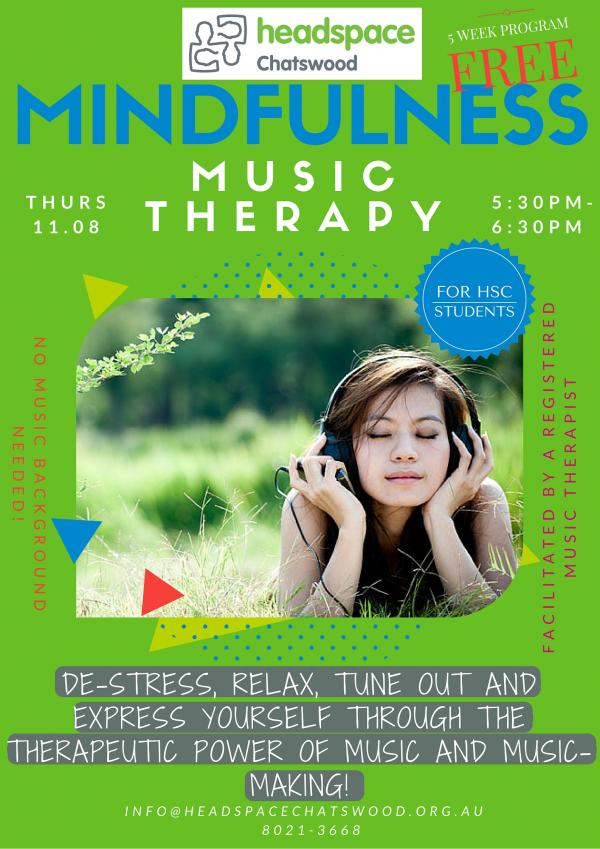
Mindfulness Music Therapy Program for HSC Students


HSC got you down? Are you stressing out?

Music therapy is a research-based practice and profession in which music is used to actively support people as they strive to improve their health, functioning and wellbeing. It's different from music education and it uses the power of music and music-making to help you get you through those tough times.

At headspace Chatswood we're offering a free 5-week music therapy program which incorporates creative mindfulness exercises for HSC students. You don't need any background in music and you don't even need to bring your own instrument.

For more information contact us on 8021-3668 or email us at info@headspacechatswood.org.au

http://www.sbs.com.au/yourlanguage/node/559373


Music Therapy Flyer 4

Wednesday, 6 July 2016

Dear all,

Just wanted to say that MOCC (Massive Online Course ) are very useful for everyone!
They are all free and are recommended for those who are interested in specific courses:
They are usually 1) Fun and interactive - with online discussions and videos
2) Easy and practical - lots of useful resources
3) Accessible and short -usually around 12 weeks and you can access it online anytime
Here are some courses worth doing -

Dementia course -
http://www.utas.edu.au/wicking/understanding-dementia
Palliative Care
https://illinoispalliativecaremooc.coursesites.com/
Here's a comprehensive list as well -
https://www.mooc-list.com/

Best regards,
Hanna

Friday, 10 June 2016

Live like you're dying

Dear all,

It's been quite a while since I've written to you all! I'm sorry for the delay as the past two months were really busy.

I would like to write about Palliative Care - I've been doing a special pilot project at the Palliative Care Ward. What the ward tells me , is about Death and Dying.When I was working with them, most of them were really trying to stay and live til the very last minute. They treasued life as much as they can, and also told me the things they wish they could have done.

 I would like to tell you about that -
1. Death is beautiful - you can die beautifully. You can be pretty and treasure death.
2. After death, there will be stage of grief and loss - it is natural and it takes time.
3. Be ready to face death - it helps you to be mentally and psychologically prepared.
4. Don't be shy about your tears - A good cry can be a good heal for you. Say what you need to say and do what you need to do for that person and for yourself.
5. Most patients just want their cloest ones to be taking good care of themselves. That will be their best wish.

Live beautifully, die beautifully.
Live as if you were to die tomorrow. Learn as if you were to live forever.
"As you grow older, you'll find the only things you regret are the things you didn't do."

A few questions to ponder :
1. Is there anything that you are pondering on doing? Do it now, don't wait. Plan it and do it. You can make it happen
2. Are there things that you wish you have done, or you have regretted doing? Don't regret before it's too late.
3. What are the things that you treasure the most now?

Thanks all, chat soon! :)

Best regards,
Hanna


Monday, 18 April 2016

Alzheimers' Disease and Music Therapy

Dear all,


How are you all? Just want to share a SBS radio interview clip about Alzheimers' Disease :
www.sbs.com.au/yourlanguage/cantonese/en/content/music-therapy-alzheimers-disease

This is in Chinese.

Best regards,
Hanna

5 Reasons Why Music Boosts Brain Activity

Music has been known to affect those with dementia and Alzheimer’s, but why it has an effect on these patients has not always been clear – until now.

Music Helps Dementia Patients Recall Memories and Emotions

A recent study shows that dementia and Alzheimer’s patients can recall memories and emotions, and have enhanced mental performance after singing classic hits and show tunes from movies and musicals – a breakthrough in understanding how music affects those with dementia and Alzheimer’s.
Researchers determined the effect music has on dementia patients, by leading half of the participants through selected songs while the other half listened to the music being played. After the musical treatment, all participants took cognitive ability and life satisfaction tests. which showed how participants scored significantly better when being lead through songs, rather than only listening.
Here are five reasons why researchers believe that music boosts brain activity:
1. Music evokes emotions that bring memories.
Music can evoke emotion in even the most advanced of Alzheimer’s patients. NeurologistOliver Sacks says that, “Music evokes emotion, and emotion can bring with it memory… it brings back the feeling of life when nothing else can.” By pairing music with every day activities, patients can develop a rhythm that helps them to the recall the memory of that activity, improving cognitive ability over time.
2. Musical aptitude and appreciation are two of the last remaining abilities in dementia patients.
Linda Maguire, lead author on the study wrote, “Musical aptitude and music appreciation are two of the last remaining abilities in patients with Alzheimer’s.” Because these two abilities remain long after other abilities have passed, music is an excellent way to reach beyond the disease and reach the person.
3. Music can bring emotional and physical closeness.
In the later stages of dementia, patients often lose the ability to share emotions with caregivers. Through music, as long as they are ambulatory, they can often dance. Dancing can lead to hugs, kisses and touching which brings security and memories.
4. Singing is engaging.
The singing sessions in the study engaged more than just the brain and the area related to singing. As singing activated the left side of the brain, listening to music sparked activity in the right and watching the class activated visual areas of the brain. With so much of the brain being stimulated, the patients were exercising more mind power than usual.
5. Music can shift mood, manage stress and stimulate positive interactions.
The Alzheimer’s Foundation of America has an entire web page dedicated to music therapy in Alzheimer’s patients. They say that, “When used appropriately, music can shift mood, manage stress-induced agitation, stimulate positive interactions, facilitate cognitive function and coordinate motor movements.” This is because music requires little to no mental processing, so singing music does not require the cognitive function that is not present in most dementia patients.

Which Musicals or Movies Work Best?

Getting a loved one with dementia or Alzheimer’s  to engage with music and movies may depend on which  genre they enjoy the most. But, the suggestions below can help you get started:
  • The Sound of Music
  • When You Wish Upon a Star (from Pinocchio)
  • Somewhere Over the Rainbow (from The Wizard of Oz)
Dr. Jane Flinn, a researcher from George Mason University says that the study should encourage caregivers.
“The message is: do not give up on these men and women. You want to be performing things that engage them, and singing is cheap, effortless and engaging.”
Do you or a loved one have any experience with music therapy for dementia? Share your story in the comments below.


http://www.alzheimers.net/2014-07-21/why-music-boosts-brain-activity-in-dementia-patients/

Thursday, 11 February 2016

Apps - are you a techie person?

Dear all,

I think everyone has been looking for resources, and it's always hard to find a definite resource. Here are some good, guided, guarded source of apps for Health, Well Being.. :) :)

I find it particularly useful for clients, caregivers and parents that if they're after their session, they can be a good resource to keep you going during the week, or to keep up with your recovery before and after the sessions with the therapy.

Apps for well-being
http://www.healthdirect.gov.au/health-and-wellbeing-apps
https://www.commonsensemedia.org/reviews/category/app/genre/health-fitness-65

Apps for Music
http://www.educatorstechnology.com/2014/10/10-great-ipad-apps-for-teaching-and.html

Apps for coping with stress, anxiety
http://psychcentral.com/blog/archives/2013/09/20/top-10-free-mental-health-apps/

Do you have more to share? Please share it with us, click "Comment" or email me!

Thanks again!

Best regards,
Hanna

Saturday, 30 January 2016

音樂療法

音樂療法

 音樂可以陶冶身心,也可以作為一種醫學療法來健身養生。音樂運動療法是
在音樂伴隨下進行適度的運動,以達到健身養生防病治病的目的,它屬自然療法
系列,對人類健康長壽有良好的效果。音樂療法又不會傷害到身體,也不會有後
遺症,所以讓我們來探討一下音樂到底能給人怎樣的好處吧。

什麼是音樂療法?
長久以來音樂被用在治療上。今天大家都知道音樂能夠影響我們的情緒和感覺。
音樂有時有鎮靜作用,有時則能使人興奮。它能使人睡著,也能在大學的足球比
賽上激起人們的興奮。它能表示我們的深情,悲痛,慶賀,和祝福。
在電梯,工作房,或百貨公司裏,柔和的幕後音樂陪伴我們。市面上有一種新興
工業,是為了設計提高商品出售和工作效率的音樂而興起的。發展並提供此類音
樂的第一家公司叫做睦扎(Muzak)。
從貝多芬的交響樂到普勒斯萊(Presley)的情歌,音樂有不同的品質,音調,和
格式。年輕人往往大聲的奏放音樂,使人不能忍受。在嬰兒室媽媽們則選擇輕柔
的催眠曲幫助他們的嬰兒入睡。
因此音樂被用做治療的工具是可以想像的。它能加快恢復,減少緊張和焦慮,使
人覺得舒服。音樂療法可以是主動的,也可以是被動的。也就是說我們可以坐下
來靜靜的欣賞它,也可以親自去演奏。兩種方式都有醫治的效果。對任何年齡、
種族、宗教、疾病的輕重,音樂都有益處。
音樂對個人或團體,不管有沒有人教你,有沒有治療師在場,或是你自己聽,都
是有效的。音樂治療師看病人的情況會選擇特別的音樂給他。音樂治療可以在醫
院、房間裏、療養院、或自己家裏做。
第二次世界大戰後不久,音樂療法被用在全美國的退役軍人醫院裏當作獨特而且
有紀律的治療方法。今天美國有許多地方在訓練音樂治療師,估計正在執業的音
樂治療師估計有5,000人。

有效嗎?
音樂療法對任何病人都有良好的效果。它能減少疼痛和減低由疾病引起的心理不
適。它對末期病人、早產嬰兒、腦部受傷的人、和慢性病的疼痛都有幫助。
音樂療法可以用在智能不足的病人、身體有障礙的人、愛滋海默症病人、和有發
育障礙的小孩。它也用在產房裡幫助產婦。在生小孩時放音樂似乎能夠減少麻醉
藥的用量。
音樂療法能夠幫助神經或發育失調的人增進身心機能。它幫助酗酒和用麻藥的病
人,減少焦慮、憂鬱、和疼痛的藥量。它也能幫助有肌肉控制問題的人恢復。
研究顯示,早產嬰兒的加護病房如有音樂,體重會增加得快一點。另外也有記錄,
音樂能夠減低即將開刀的小孩子的焦慮,和促進聽力有障礙的人學習講話的能
力。音樂用在牙科診所舒解治療牙齒的疼痛,並幫助中風病人的恢復。
音樂療法不能醫好疾病。但是有許多科學根據支持它對各種疾病的病人有眾多益
處。它能減輕症狀,幫助復原和康復,增進生活品質。它是低價的,設備簡單的,
而且能夠在任何環境裏使用。


音樂能夠用來做為治療的輔助或者主要工具,是由於它具有很多除了旋律與節奏
之外的潛在特性,聆聽音樂或者演奏樂器,可以獲得除了樂音之外的「外部經
濟」:
A、音樂能直接影響一個人的內在感情
B、音樂能使一個人得到對“美”的滿足感
C、音樂能誘發一個人的活動力
D、音樂是多元性的
E、音樂是一種非語言的溝通工具
F、音樂有一定的構造性與組織性
G、音樂活動能使一個人感到自我滿足
H、音樂活動能促進一個人統合運動機能
I、音樂活動能幫助一個人宣洩內在的情緒
J、團體音樂活動能幫助促進人際關係(註四)

http://www.shs.edu.tw/works/essay/2007/03/2007033112072741.pdf